Design & Critical Thinking: The Innovation’s power duo
“Design Thinking” has graduated from a niche methodology to a ubiquitous business buzzword. While often celebrated in boardrooms as a silver bullet for innovation — visualized as a flurry of colorful sticky notes — this surface-level understanding misses the critical nuances that make the framework truly functional.
The popular depiction of Design Thinking as a linear, happy-path process overlooks its complexities and limitations. To move from performative innovation to strategic mastery, we must look behind the curtain.
Here are seven truths that transform the methodology from a creative exercise into a rigorous tool for problem-solving.
1. It’s Not Just for Designers (But It’s Not the Only Way to Design)
We must distinguish the specific paradigm of Design Thinking from the broader professional practice of Design.
Design is a vast, multifaceted discipline. Design Thinking, conversely, is a codified method for creative problem-solving packaged for accessibility. Scholarly analysis defines it by specific principles — user-centeredness, ideation, and iterative prototyping — that can be leveraged by non-designers, from product managers to researchers.
Its widespread adoption stems from this accessibility. It provides a structured, human-centered framework that empowers cross-functional teams to tackle ambiguity. However, it is merely one paradigm within the broader universe of design; it is not a replacement for deep craft or specialized expertise.
2. The Cognitive Engine: Abductive Reasoning
To truly understand the link between design and critical thinking, we must look at the logic that drives them. Most business education focuses on Deductive Reasoning (proving the specific from the general rules) or Inductive Reasoning (inferring general rules from specific data).
Design Thinking, however, relies on Abductive Reasoning. This is the “logic of what might be.”
- Deduction analyzes what is to prove truth.
- Abduction hypothesizes what could be to explore possibility.
This is where the mental model of the researcher must shift. You cannot prove a future concept using only historical data (Induction). You must take a logical leap based on observed patterns to create a new hypothesis. Critical thinking in design is not just about analyzing data; it is about rigorously evaluating the quality of these abductive leaps.
3. The User-Centricity Trap: When “Userism” Stifles Innovation
The core tenet of Design Thinking is a relentless focus on the user. While this grounds solutions in human needs, it creates a specific blind spot.
Traditional Design Thinking operates in a Positivist / Single User quadrant. It seeks to solve defined problems for specific personas. However, an extreme focus on the user — what we might call “userism” — traps teams in a path-dependent trajectory. By focusing heavily on fixing current user frustrations, teams often optimize the past rather than imagining a new future.
For “wicked problems” (systemic issues like sustainability or AI ethics), this is insufficient. These challenges are Constructivist — the problem itself is ambiguous and must be framed — and involve multiple stakeholders with conflicting incentives.
4. The Critical Partner: Why Creativity Fails Without Rigor
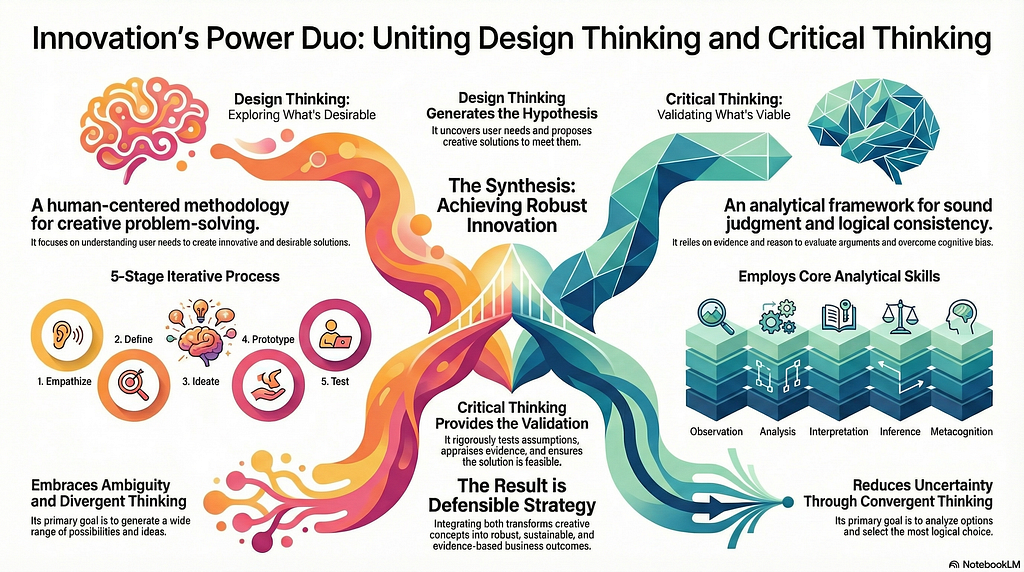
Design Thinking and Critical Thinking are not opposing forces; they are the necessary dialectic between divergence and convergence. Design Thinking is fundamentally generative, while Critical Thinking is evaluative.
Without the evaluative partner, the generative process is merely brainstorming. Critical thinking provides three distinct layers of rigor:
- The Logic Check: While Design Thinking relies on narrative and emotion, Critical Thinking relies on logic and evidence. It assesses whether a concept is structurally sound or merely a “happy path” fantasy.
- Bias Detection: Design Thinking encourages empathy, which is subjective. Critical Thinking introduces objectivity, identifying cognitive biases (such as confirmation bias or the sunk cost fallacy) that might lead a team to fall in love with a flawed solution.
- Feasibility & Viability: A solution can be desirable to a user but disastrous for a business model or technically impossible. Critical thinking acts as the quality control mechanism, ensuring that the “innovation” is actually implementable.
5. The “Groan Zone”: The Psychology of Convergence
The double diamond diagram makes the process look symmetrical and neat: you flare out (diverge) and you narrow down (converge). In reality, the space between these two is distinct and painful.
Facilitator Sam Kaner calls this the “Groan Zone.” This is the moment when the team has generated too many ideas, the complexity is overwhelming, and no clear solution has emerged.
Novice practitioners often try to rush through this phase because it is uncomfortable. They force a premature convergence just to relieve the cognitive tension. However, a master practitioner uses critical thinking to stay in the Groan Zone, tolerating the ambiguity long enough to synthesize disparate ideas into a coherent whole. This ability to sustain mental discomfort is a hallmark of critical thought.
6. The Empathy Illusion: Performing vs. Understanding
Empathy is the centerpiece of the framework, yet it is susceptible to “performative empathy.” This occurs when researchers believe they understand a user’s complex mental model after a handful of interviews, or when “representation bias” leads teams to assume a small sample size represents a total population.
True empathy requires critical self-reflection. The goal is not just to understand the user, but to use that understanding to challenge the researcher’s own assumptions. This aligns with Equity-Centered Design, which forces practitioners to confront their own blind spots and power dynamics rather than simply extracting data from users.
7. The Golden Rule: Prototype Right, Test Wrong
The most counter-intuitive mindset in Design Thinking appears in the validation phase. The purpose of testing is learning, not winning.
The Stanford d.school captures this distinct mental model:
“Always prototype as if you know you’re right, but test as if you know you’re wrong.”
This is the antidote to confirmation bias. When you build with confidence, you ensure the fidelity of the idea. But when you test with the explicit goal of breaking the prototype — of finding where the logic fails — you move from seeking validation to seeking truth. This rigor ensures the final solution is robust, defensible, and ready for the real world.
Conclusion: From Process to Mindset
Design Thinking is not a linear recipe; it is a philosophy for navigating ambiguity. Its potential is only unlocked when practitioners pair its creative energy with critical rigor.
By understanding these nuances — specifically the interplay between Abductive reasoning and critical evaluation — you move beyond the sticky notes and into the realm of true strategic innovation.
Fredy Pascal
Principal Service Design
Ciao ciao
Design & Critical Thinking: The Innovation’s power duo was originally published in Bootcamp on Medium, where people are continuing the conversation by highlighting and responding to this story.