Design Concept VS Concept Design
Why Product Designers and Service Designers often don’t speak the same language
After more than 10 years working in design, one thing has become very clear to me: “designer” is not a universal role. The title may be the same, but the mindset, expectations, and scope behind it can be radically different depending on context — especially geography.
Around the world, the same title (UX Designer, Product Designer,Service Designer) can mean entirely different things.
For example, in France and Belgium, UX Designers are often expected to cover the end-to-end experience. Their role overlaps heavily with what many organizations would call Service Design: research, journey mapping, problem framing, concept exploration, and experience orchestration and design high fidelity experiences.
In Germany or Canada, on the other hand, the market expectation is often very different. Designers are frequently positioned closer to execution: translating product requirements into interfaces and shipping designs defined upstream by PMs or stakeholders — sometimes regardless of seniority.
Yes, these are high-level generalizations. Of course, excellent designers conducting research and shaping strategy exist everywhere. But market expectations shape behavior, and context always matters. Titles are cultural artifacts.
To understand where the disconnect comes from, it helps to go back to fundamentals.
Two mindsets in the UX realm
At a high level, there are two dominant design mindsets operating in the UX ecosystem today:
Product Designers
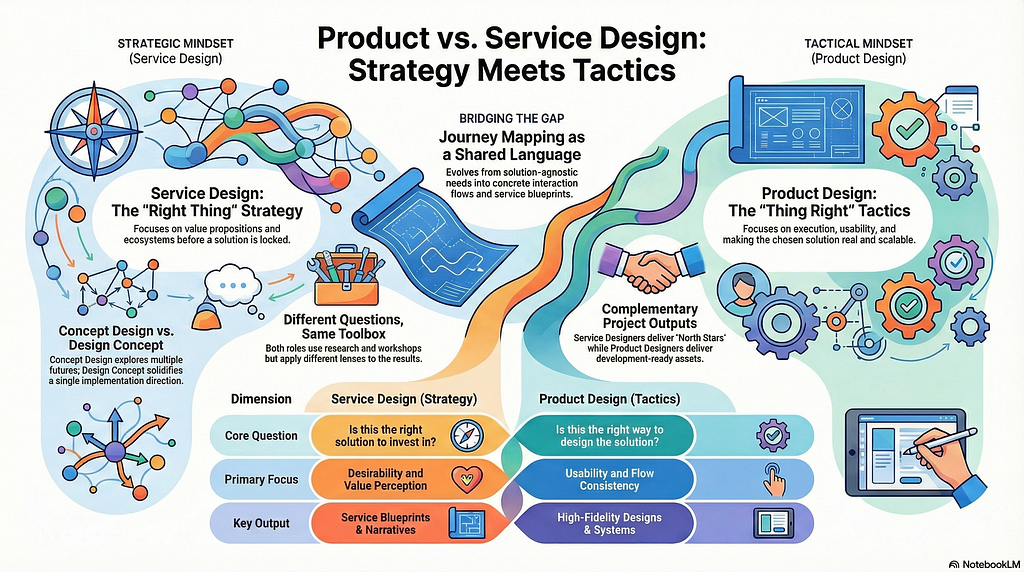
Product Designers are primarily focused on:
- Interaction design
- Interface details
- Usability
- Flow consistency
- Execution quality
- Design System Management
- UX usability patterns & Heuristics
They usually start from a chosen direction and ask:
“What is the best way to design this solution so it actually works for users?”
Their job is to make the solution real, usable, coherent, and scalable.
They are more close to execution than strategy.
Service Designers
Service Designers focus more on:
- End-to-end journeys
- Ecosystem thinking
- Multi-channel experiences
- Value propositions
- Organizational feasibility
They usually operate before a solution is locked and ask:
“Is this the right solution to invest in at all?”
Their role is to challenge assumptions, open the problem space, and ensure the organization is solving the right problem before committing resources, effort and time.
They are more close to strategy than execution.
Where the gap starts
Over time, a mental gap has grown between these roles — not because they are opposed, but because they intervene at different moments of the lifecycle.
- Product Designers challenge how a solution is crafted and integrated into the experience.
Their core question is:
“Is this the right way to design the prioritized solution?” - Service Designers challenge whether the solution itself makes sense.
Their core question is:
“Is this the right solution to deliver in the first place?”
Both are option-oriented, but at different stages:
- Product Designers explore design options within a solution
- Service Designers explore solution options within a high level problem space
This is the critical distinction that often gets blurred.
Design Concept vs. Concept Design
This is where the confusion often peaks.
- Concept Design (Service Design mindset)
→ Exploring multiple futures
→ Testing desirability before usability
→ Framing value propositions
→ Keeping options open - Design Concept (Product Design mindset)
→ Solidifying a direction
→ Designing interactions and flows
→ Making trade-offs
→ Preparing for implementation
When these two phases are mixed — or when one is skipped — the collaboration breaks down.
The overlap: Journey mapping as a shared language
There is a powerful overlap between Product and Service Design — and it’s often the best entry point for collaboration: the journey map.
For Service Designers, journey maps can be:
- Solution-agnostic
- Based on mental models
- Focused on needs, pains, and opportunities
For Product Designers, journey maps are often:
- Solution-centered
- Anchored in flows and touchpoints
- Used to design interactions and transitions
When done together, journey maps naturally evolve into:
- Service Blueprints (As-Is and To-Be)
- A shared understanding of feasibility, desirability, and viability
- A bridge between strategy and execution
This is where teams can test future possibilities, align on direction, and then confidently move into interaction design.
Different outputs, same purpose
The outputs of these roles are different — but complementary.
Product Designer outputs
- Zoning and wireframes
- Low-fidelity prototypes to validate interactions
- Detailed user flows
- High-fidelity designs aligned with the design system
- Assets ready for development
- Usability testing
These outputs answer:
“Can users complete their task easily and confidently?”
Service Designer outputs
- Storytelling and narratives
- North Star concepts
- Value proposition design
- Future State Service Blueprints
- Landing pages or concept prototypes (often powered by AI today)
These outputs answer:
“Do users want this experience at all?”
Not everything needs to be implementation-ready to be valuable. Sometimes, desirability is the real risk to test.
Strategy vs. tactics: the real distinction
Ultimately, both roles serve the business by answering two fundamental questions:
- Do we design the right thing?
→ Strategy
→ Market Problem framing
→ Service Design - Do we design the thing right?
→ Tactics
→ Execution
→ Product Design
Organizations that confuse these questions often:
- Over-invest in execution too early or too often without have a clear strategy or de-risk the only solution they crafted
- Lock solutions before validating value and the problem space
- Enter in the problem space with the solution in mind and force the solution to fit the problem
- Or, on the opposite side, stay stuck in ideation without delivering the value to impact the user experiences and business KPIs
A common misconception about Service Design
One last myth worth addressing:
“Service Designers are mainly user researchers.”
I strongly disagree.
There is no fundamental difference between Product and Service Designers in terms of tools, methods, or activities:
- Both can do user research
- Both can run workshops
- Both can prototype
- Both can test with users
The real difference is coverage in the lifecycle, not capability.
- Product Designers tend to focus research on usability, comprehension, and interaction
- Service Designers tend to focus research on needs, expectations, and value perception
Different lenses. Same toolbox.
Final thought
Product Design and Service Design are not competing disciplines.
They are two lenses on the same reality.
When they don’t “speak the same language,” it’s usually because:
- The organization hasn’t clarified which question needs answering
- Or one role is asked to compensate for the absence of the other
The strongest teams I’ve seen don’t argue about titles. They align on intent, timing, and decision level in a common and shared Product Lifecycle that is designer in 3 parts (Triple Track Agile)
The Triple-Track Lifecycle: How to align strategy, tactic and development
- Strategy design: Design the right thing
- Tactic design: Design the thing right
- Execution design: Delivery the right thing right
There is a 4th dimension that I call Measurement & Analytics that do not follow a proper plan but have to be done continuously to impact the 3 tracks when design their roadmap.
That’s where real design impact lives.
Fredy Pascal
Principal UX Strategist & Service Designer
Ciao ciao
Design Concept VS Concept Design was originally published in Bootcamp on Medium, where people are continuing the conversation by highlighting and responding to this story.