Balancing Creativity, Analysis, and AI in Modern UX Research Practices
Mastering UX Research in the Age of AI Without Losing the Human Touch

Let us begin with the fundamentals and assume that everyone is already familiar with two essential notions:
- Artificial Intelligence (AI), whether in its generative or assisted forms;
- User Experience (UX) Research, whether generative or evaluative in nature.
With this shared foundation, we can move beyond definitions and focus on a more meaningful reflection — a simple yet crucial question:
Why use AI in your UX research workflow?
The answer is straightforward: why not?
It is no different from asking, “Why do you use recruiting services to find participants for interviews?” Tools exist to be leveraged — to increase efficiency, enhance quality, and expand our capabilities as researchers.
The real differentiator lies not in the tools themselves but in the mindset with which we approach them. Embracing an agency mindset means being open to experimentation, exploring new methodologies, and continuously seeking improvement rather than relying on established routines. Statements such as “We have never done this before” or “AI will never replace human judgment” often stem from a fixed mindset — one that limits growth.
Shifting toward an explorative mindset allows researchers to integrate AI not as a replacement for human insight, but as a catalyst for innovation, creativity, and deeper understanding.
Do not act like the Prof. Umbridge… act and think like Dumbledore.
I am personally opposed to using AI merely for the sake of appearing innovative. The same applies to organizations that rush to integrate AI into every process without taking the time to strategize, align with clear objectives, or start from genuine user and business needs.
My reasons for integrating AI into my workflow are deeply pragmatic and grounded in my professional needs as a researcher and designer. I use AI to:
- Refine language and structure content — as a non-native English speaker, it helps ensure clarity, coherence, and professionalism in my communication.
- Gain a second analytical perspective when reviewing core data and evidence, allowing me to challenge assumptions and enrich insights.
- Focus on the essence of my work — engaging with people, gathering evidence, and understanding experiences — while delegating repetitive or secondary tasks.
- Enhance accessibility of research findings by presenting them in formats and narratives that stakeholders can easily understand and act upon.
Before integrating any new tool or technology — including AI — into my workflow, I always evaluate it against a few essential criteria. Naturally, this begins with a phase of testing and experimentation, as understanding a tool’s true value requires firsthand experience.
I adopt a new tool only if:
- It enhances the quality of my outputs by helping me create more accurate, coherent, or meaningful content.
- It augments my thinking rather than replacing it — complementing my expertise and enabling me to reach deeper or broader insights.
- It allows me to accelerate low-risk, high-effort tasks, so I can concentrate my time and energy on the core, high-impact, and riskier aspects of research and design that demand human judgment and empathy.
How Do I Use AI in Practice?
Whenever I integrate AI into my work, I follow a clear principle designed to ensure that the technology strengthens — rather than weakens — my analytical and creative thinking. My goal is to get the best from AI, while also getting the best out of myself.
My guiding rule is simple:
Start from your own ideas and cover 80% of the work yourself. Then use AI to refine, enhance, and complete the remaining 20%.
This balance allows me to maintain full control over the direction of my work while using AI strategically to improve quality, coherence, and depth. It ensures that the core thinking — the insights, interpretations, and creative choices — remains entirely human-driven.
Here is how I typically apply this approach:
- Create your own content first.
Begin with your raw ideas. Do not worry about language, grammar, or syntax — the goal is to externalize your thinking freely and authentically. - Enhance and refine with AI.
Use AI to strengthen the structure, clarity, and tone of your material. Provide clear instructions for what you need at each step of your research process and specify the desired format for the output. (For instance, in Step 6 — Analyse and Shape Insights — I will share an example of how this can be done.) - Control and verify before sharing.
Always review, validate, and adjust the AI-generated output before using or presenting it to stakeholders. This final review ensures that the message remains aligned with your research intent and organizational context.
Let’s deep dive into my day to day as a researcher using AI…curious ?
I will now share my personal experience by walking through the typical phases of a user research project, illustrating where and how I integrate AI — and where I intentionally choose not to.
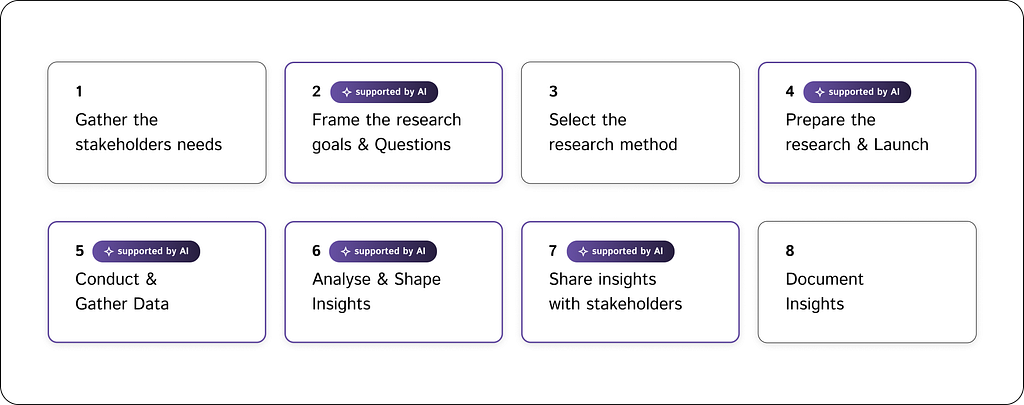
The following represents my “Job-to-be-Done” map for conducting a research study, showing how AI supports different stages of the process. It provides a visual overview of when AI adds value, why it is used, and when human judgment and creativity must remain at the forefront.
1. Gather the stakeholders needs
I consider this the most critical step in organizing any research initiative, well before data collection begins — whether the data originates from surveys, interviews, usability tests, or data mining.
This stage is essential to define the strategic impact of the research: understanding why stakeholders need certain insights, what goals and expectations they hold, and which research questions must be answered to drive meaningful outcomes.
Why I do not use AI at this stage:
I have established a simple and human-centered process for gathering this information directly from colleagues and stakeholders. Introducing AI tools here would only add unnecessary complexity and distance to what must remain a highly relational and collaborative activity.
The intake phase of a project should stay between humans — allowing for flexibility, dialogue, and the opportunity to ask deeper questions. This direct interaction helps to refine the research scope collaboratively and to build engagement for future research activities.
2. Frame the research goals & questions to answers (Supported by AI)
Once the stakeholder intake phase is completed, the next step is to reframe and synthesize what has been learned. This involves translating the collected information into clear and actionable components:
- The goal and purpose of the study
- The expected impact on the business or organization
- The research questions to be addressed through insights
- The expectations set by stakeholders regarding outcomes and deliverables
How I use AI at this stage:
At this point, the role of AI is supportive rather than generative. I use it primarily to refine, reframe, and clarify the content that I have already created based on stakeholder discussions. The value lies in improving precision, structure, and readability — ensuring that the objectives and messages are expressed clearly and effectively.
This is a simple yet powerful application of AI. By re-reading the enhanced version produced by the model, I can quickly identify gaps, confirm that my reasoning holds, and validate whether I am ready to proceed to the next phase of the project.
Which AI tool do I use?
I prefer to work with a single model that can adapt to multiple tasks. However, I strongly recommend that each professional develops their own personalized AI agent — one that aligns with their workflow and way of thinking. (More on this later in the article.)
My preferred tool is Perplexity, a platform designed for research-oriented tasks. It draws on multiple AI models and sources depending on the type of query. In my view, using a research-specialized tool to support research-related work simply makes sense.
3. Select The Research Method
Once all the necessary information is gathered and the research questions are clearly defined, the next step is to determine the most appropriate research method — or a combination of methods — to effectively answer those questions.
In my view, this decision should always be guided by the researcher’s expertise, judgment, and experience. Selecting the right approach requires considering several key factors:
- Time: How much time is available to collect and analyze meaningful insights?
- Effort: What level of effort can be dedicated to this project given the current workload?
- Risk: How critical or sensitive is the topic for the business? What are the potential consequences of error or inaction?
- Resources: What tools, budget, and team support are available to conduct the study effectively?
- Type of data needed: Do you require qualitative insights, quantitative data, or a mixed-method approach?
- Stage in the product or service lifecycle: Are you in a discovery, concept testing, evaluative, or optimization phase? Each requires a distinct methodological approach.
Why I do not use AI at this stage:
I believe AI, despite its analytical capabilities, cannot yet grasp the full contextual and organizational nuances in which research decisions are made. While it can be informed about the tools, domain, or constraints, it lacks the situational awareness and creative reasoning necessary to design a research strategy that truly fits the complexity of a given environment.
For junior researchers, AI suggestions can offer a sense of direction or reassurance when exploring methods. However, for experienced researchers, these recommendations often remain too generic or detached from the specific realities of their company or project.
If one chooses to use AI at this stage, it should be seen merely as a source of inspiration — a starting point for reflection — not as a decision-making engine. Ultimately, the choice of method should remain a human decision, rooted in expertise, creativity, and critical thinking.
4. Prepare the research & Launch (Supported by AI)
At this stage, all foundational elements are in place to begin preparing the research protocol — which includes the script, planning, timeline, and ultimately, the launch of the data collection phase.
This is often one of the most time-consuming stages in a research project. It requires careful formulation and refinement of scripts — whether for interviews, surveys, fake-door tests, or prototype evaluations. The key here is ensuring a strong Research Question–Script Fit: each core research question should correspond to a structured set of sub-questions that collectively help uncover the right insights.
How I use AI at this stage:
This is where I begin applying the core principle introduced earlier — combining my own work with AI refinement in an 80/20 ratio.
- Start from my own draft.
I first write the main questions or tasks by myself, guided by the research objectives and the prototype or concept to be evaluated. During this step, I do not worry about repetition or precision; my focus is on freely exploring ideas and formulations, whether direct, broad, or even biased. - Provide the full research context.
Once my initial draft is ready, I share with the AI the research information — including goals, business purpose, and research questions — and ask it to generate a second version (V2) of the script that aligns with these objectives. - Refine through iteration.
I then review the AI’s proposal and start a collaborative refinement process. This phase is crucial to tailor the questions to my company’s context, adjust key terminology, and ensure that the language reflects the culture and priorities of the stakeholders involved. - Simplify and ensure alignment.
I always request that the AI simplifies the structure, shortens lengthy or redundant questions, and clarifies the logical flow. Each question must be explicitly linked to the corresponding research question to maintain focus and coherence throughout the script. - Check for bias and ethics.
As a final step, I ask the AI to identify and reduce potential biases in question wording and to ensure that the overall script adheres to ethical research standards.
5. Conduct and Gather Data (Supported by AI)
This is the stage where you begin collecting evidence based on the research methods you have selected. Whether it involves conducting interviews, sending surveys, tracking responses, or observing participants in controlled or natural environments, this is the phase where direct engagement with users is essential.
How I use AI at this stage:
For me, the most important aspect is the verb “conduct”, not merely “gather”. Human presence, empathy, and active observation are critical for connecting with participants and truly understanding their behaviors, motivations, and pain points. For this reason, I do not rely on AI to conduct research sessions.
AI’s value here lies in supporting data structuring and documentation:
- Taking notes: Capturing conversations or observations efficiently.
- Aggregating initial data: Transforming raw information into a structured format that is easier to analyze.
- Preserving evidence: Ensuring that insights are stored systematically for subsequent stages.
One tool I frequently use is Google Meet AI, which provides transcriptions and summaries of live sessions. These outputs serve as essential raw data for the next step — data analysis and insight synthesis — while allowing me to focus fully on observing, listening, and interacting during the session.
6. Analyse & Shape Insights (Supported by AI)
At this stage, you have gathered all raw data from interviews, observations, surveys, or other sources such as NPS scores. The goal now is to analyze the data and extract actionable insights and opportunities.
I always begin by following my own method: I start with what is in my mind first, jotting down a simple list of initial learnings and impressions that immediately stand out. This ensures that my intuition and expertise remain central to the analysis process.
How I use AI at this stage:
To support deeper analysis, I create my AI “twin” in Gemini, which I treat as an analytical assistant — a “Gem” — designed to help organize and structure my thoughts.
I provide my AI twin with a clear prompt and detailed instructions, guiding it to:
- Analyze the collected data systematically.
- Identify patterns, trends, and anomalies.
- Generate a detailed list of insights and opportunities.
- Assist in connecting observations to broader research questions or business objectives.
The AI’s role here is supportive, not substitutive. It helps structure, expand, and clarify my findings while I retain full control over interpretation, prioritization, and decision-making. By combining my human intuition with AI-assisted analysis, I can accelerate the synthesis process without compromising the contextual and strategic understanding that only a researcher can provide.
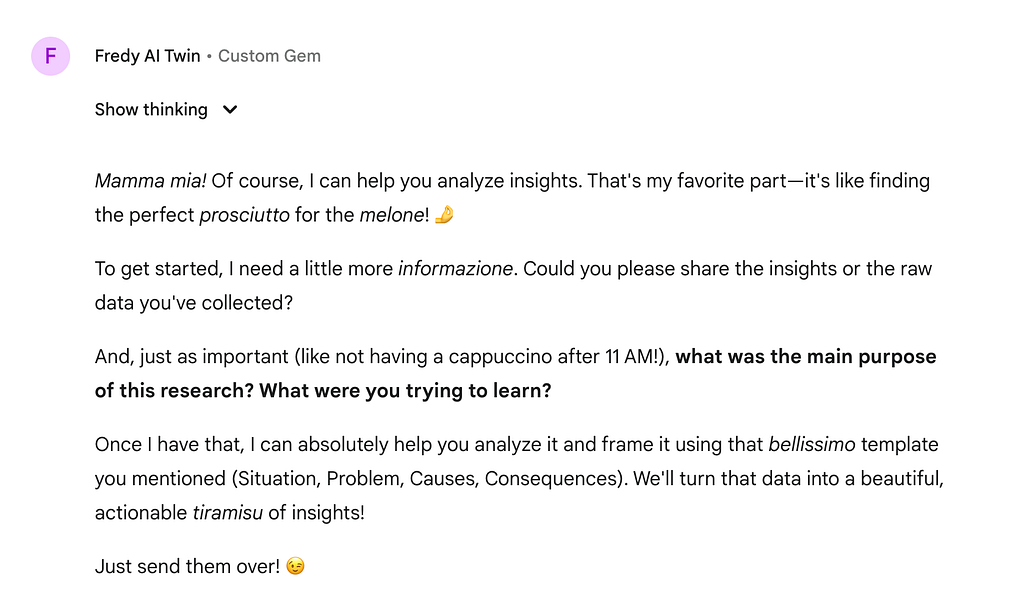
First of all, I gave to my AI Twin the template to use to analyse the raw data:
Insight Generation:
📍Situation: When and where people experience the problem
🚨 Main Problem: What is the main problem or unmet need
🚧 Causes: Possibles list of root causes triggering the main problem
🤯 Consequences: Possibles lit of consequences as the negative outcome
Opportunities Generation:
💬 Title of the recommendation: The main direction or room of improvement
✅ Purpose: Description of the opportunity
🎯 Outcomes: The impact of this opportunity for the business and user experience
After generating insights, I use my AI twin to identify opportunities by linking them across multiple insights. One opportunity can be associated with two, three, or even more related insights, providing a holistic view of patterns and potential actions within the same topic.
Once the AI produces its output, I carefully review and refine it. This involves:
- Adjusting wording to ensure clarity, tone, and readability.
- Adding context specific to the domain, business, or organizational terminology.
- Ensuring that the final set of insights and opportunities aligns with company priorities and language, making it actionable and relevant for stakeholders.
7. Share insights with stakeholders (Supported by AI)
Now it is time to communicate what you have learned — and ideally, make it digestible, engaging, and even enjoyable. Gone are the days of long, monotonous presentations where a researcher talks for two hours and stakeholders leave with more questions than answers.
How I use AI at this stage:
I leverage Notebook LM to transform research findings into interactive and engaging presentations. This approach allows me to:
- Present insights in different formats, tailored to the audience’s focus and interests.
- Reduce the time required to share findings, making the process more efficient for both the researcher and stakeholders.
- Enable stakeholders to interact directly with the AI, effectively giving them an “AI research expert” they can query for clarification or deeper exploration of specific topics.
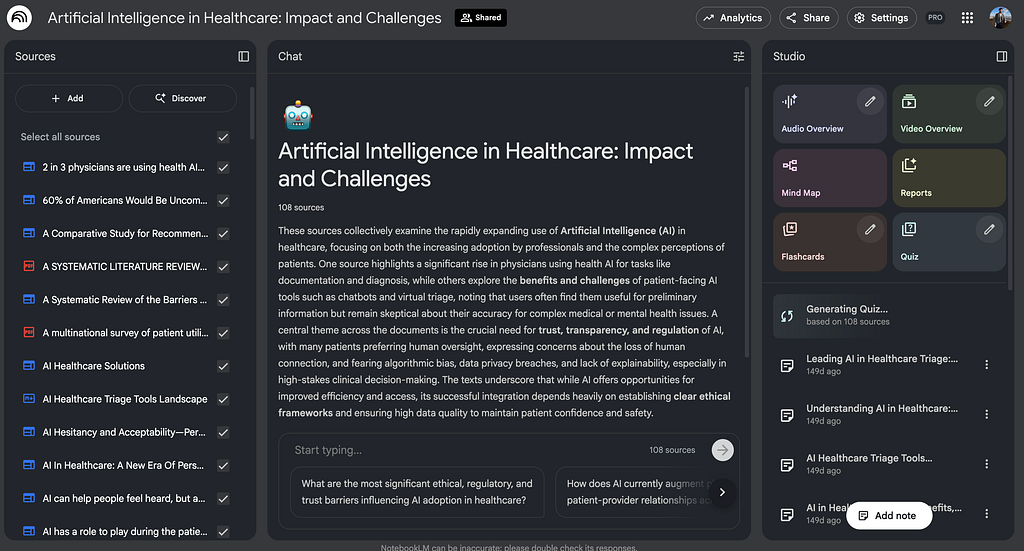
Once the insights and opportunities have been crafted and uploaded — whether across multiple documents or consolidated in a single Google Doc — I create multiple outputs to communicate the findings effectively:
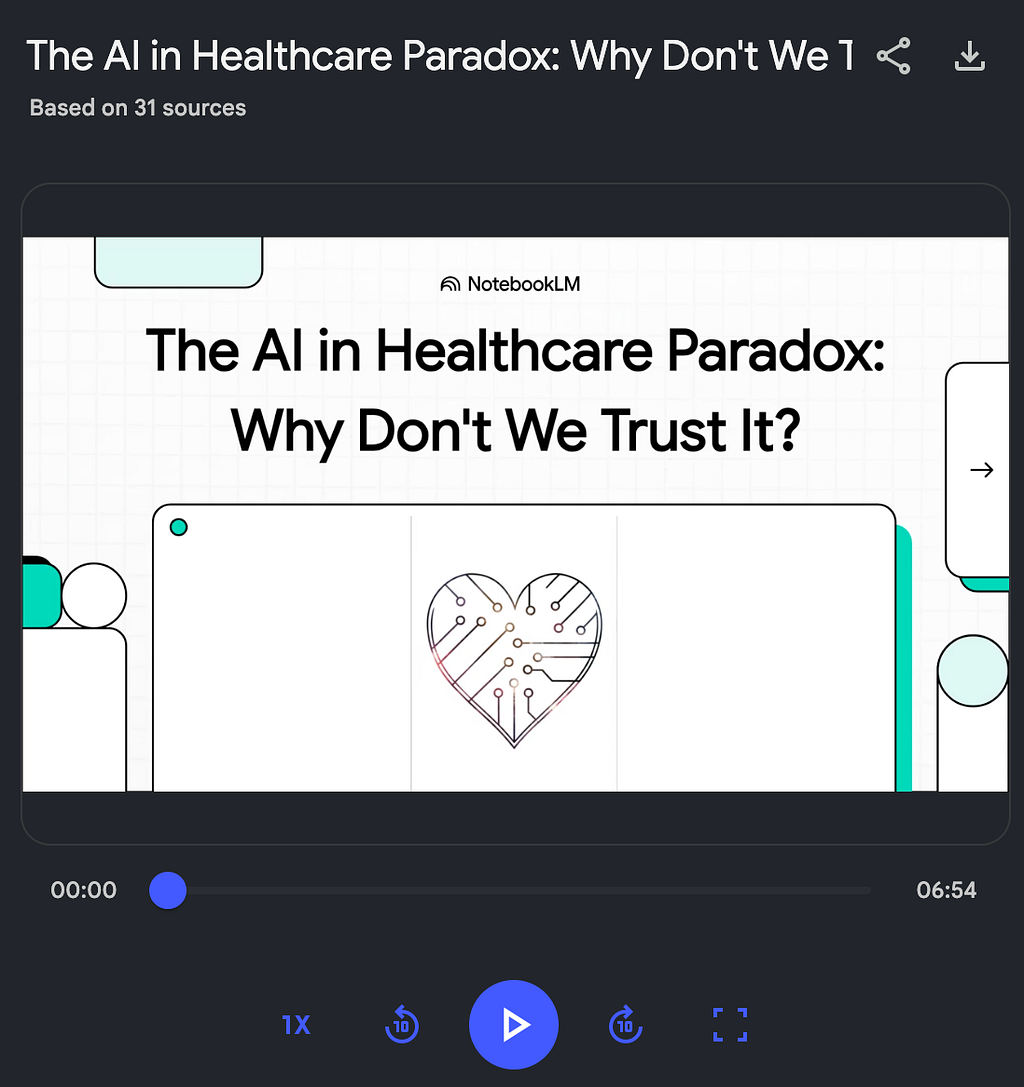
- Video summary: I generate a concise video highlighting the most important insights and recommendations, using prompts to ensure the focus aligns with what stakeholders need to know.
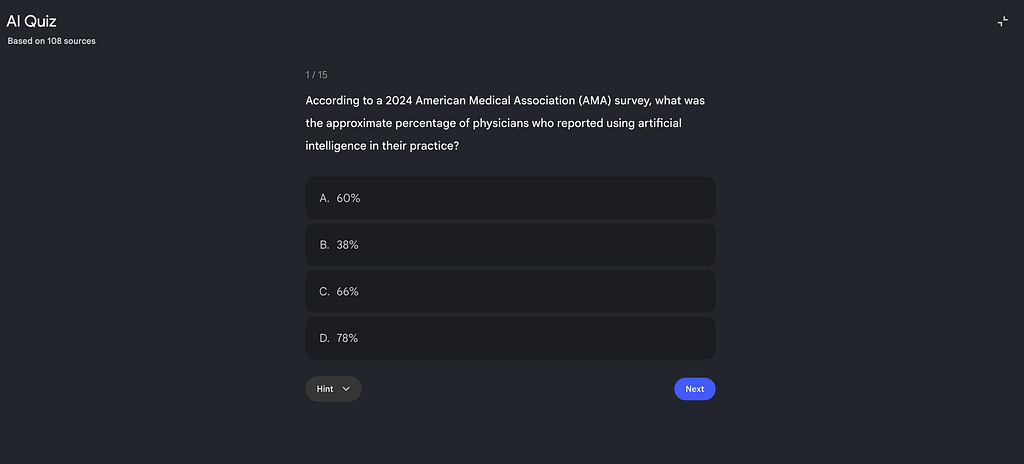
- Interactive quiz: To make the session engaging and test comprehension, I create a quiz based on the video content. This allows participants to interact, have fun, and reinforce key learning points.
- Brief summary: Finally, I use AI to produce a simple brief that captures the core insights and opportunities, providing a compact reference for stakeholders after the session.
The presentation flow follows a structured, engaging logic:
A. Begin by sharing the main purpose of the research and outlining the expected outcomes.
B. Play the video (4–6 minutes max) to present the initial insights and capture stakeholder attention.
C. Launch the quiz to verify understanding and provide additional context as participants answer questions.
D. Present the final opportunities, linking them to insights and key recommendations.
E. Address any live stakeholder questions. If needed, I leverage AI in real time via chat to support answers, while also capturing and saving this knowledge for future reference.
8. Document Insights
Documentation remains a core part of research, even if it is more aligned with ResearchOps. I prioritize maintaining a structured research library to classify and categorize all studies. This approach ensures that insights are easily retrievable and shareable with key stakeholders, avoiding the need to start from scratch for each new project.
Although AI is not heavily used during this stage, creating thorough, organized documentation lays the foundation for future AI-assisted work. I use Notion to store all studies in a dedicated library (database), tagging each study with relevant criteria and metadata.
A well-structured database enables AI tools — like Notion AI — to:
- Aggregate insights for a specific topic without manually reviewing each document.
- Provide faster and more accurate qualitative responses based on the structured data.
Even though reviewing original studies is still valuable for in-depth understanding, a properly organized library ensures that AI agents can efficiently surface relevant insights.
Recommendation:
If you use Notion, start by creating a research library using a database structure. Over time, this allows you to query Notion AI directly for insights from past research, dramatically reducing effort while maintaining accuracy and context.
Right AI tools at the right time
As you can see, I select specific AI tools for the right moments in the research lifecycle, rather than relying on a single, all-in-one solution. I find that task-specific tools provide greater reliability and trust, as they focus on one function and execute it well.
I am confident that this approach will continue to evolve, as we have seen over the past two years. Yet, I firmly maintain that UX research remains a fundamentally human activity. AI should be treated as a facilitative tool, designed to enhance access to knowledge, streamline processes, and support analysis — but never to replace the core of our work: engaging with people, observing behaviors, and uncovering insights directly from users.
This mindset ensures that AI amplifies human expertise without diluting the critical human connection at the heart of research.
Ciao ciao,
Fredy Pascal
Principal Service Designer
Balancing Creativity, Analysis, and AI in Modern UX Research Practices was originally published in Bootcamp on Medium, where people are continuing the conversation by highlighting and responding to this story.