Why Quant-First Strategies Blind Your AI and Your Business

We live in an era paralyzed by the illusion of objectivity. Look at any modern corporate boardroom, and you will see the same ritual: leaders gathered around vibrant dashboards, tracking conversion funnels, churn coefficients, and user telemetry. It feels safe. It feels rational. After all, numbers don’t lie, right?
But numbers do something far more dangerous: they omit.
When we treat quantitative data as our starting line, we commit a fundamental strategic error. Quantitative data can only measure what already exists within the parameters of what you decided to track. It can tell you the velocity of the water flowing through a pipe, but it will never tell you that you are piping the wrong liquid to the wrong house.
To build experiences, products, and AI systems that actually resonate with human beings, we have to flip the current paradigm on its head. We must start with empirical, qualitative exploration to open up the entire landscape of human realities, use AI to map the non-linear patterns within that mess, and only then bring in quantitative analysis to prioritize and scale.
1. The Trap of the Statistical Starting Line

When you start a project by looking at a spreadsheet or an analytics dashboard, you are suffering from what behavioral scientists call the “Streetlight Effect.”
The old joke goes like this: A police officer sees a drunk man searching for his keys under a streetlight. The officer asks, “Is this where you lost them?” The man replies, “No, I lost them down the block, but this is where the light is.”
In the business world, dashboards are our streetlights. We look at click-through rates, bounce rates, and time-on-page because they are brightly lit and easily accessible. But the real opportunities — the hidden frustrations, the emotional anxieties, the unspoken needs — are waiting down the block in the dark.
The Danger of Optimizing the Wrong Room
Consider a real-world scenario: A telehealth platform notices a staggering 45% drop-off on step three of their patient onboarding flow — the “Upload Medical History” screen.
- The Quant-First Approach: A data analyst runs a regression model, tracks session recordings, and concludes that the file-upload mechanism is too slow or the button is poorly positioned. The product team spends three weeks redesigning the button, optimizing file compression, and streamlining the UI. The conversion rate inches up by a meager 2%.
- The Empirical Qual-First Approach: A researcher goes into the field and sits with users during onboarding. They observe a mother trying to complete the form. When she reaches step three and reads the clinical, cold prompt asking for a “Comprehensive list of chronic hereditary conditions,” she freezes. She looks at her sick toddler, tears up, and closes the app.
The problem wasn’t a slow file uploader; the problem was emotional friction. The quantitative data accurately flagged where the leak was, but because the team started with numbers, their imagination was instantly trapped within the boundaries of the existing interface. They optimized a room that the user didn’t even want to be in.
Quantitative data compresses rich, messy human behavior into rigid binary points. If you start there, your strategy is instantly deformed by the limitations of your current tracking setup.
2. Rational Thinking vs. Empirical Reality
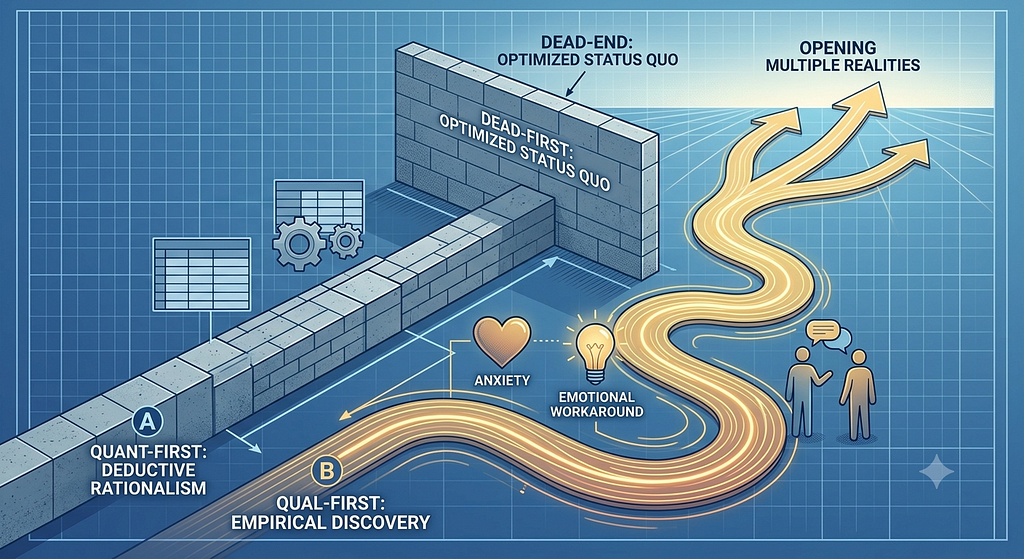
The tension between starting with statistics and starting with human observation mirrors a deep philosophical division: Rationalism vs. Empiricism.
A rationalist approach relies on pre-existing frameworks, deductive logic, and structural models. In business, this looks like saying, “According to our market segmentation model and historical trends, a user in demographic X will want feature Y.”
An empirical approach, however, demands direct observation of the world as it actually behaves, free from the bias of pre-existing schemas.
Dimensions
Rational / Quantitative First
Empirical / Qualitative First
The Core Belief -
-If it cannot be measured and mapped, it is speculative or irrelevant.”
-Let’s observe the messy reality first, then figure out how to structure it.”
Starting Point
-Existing databases, telemetry dashboards, and market reports.
-Direct contextual inquiries, ethnographic observation, and deep-dive interviews.
Strategic Bias
-Optimizes the status quo. Focuses heavily on efficiency and incremental gains.
-Discovers entirely new paradigms. Focuses on effectiveness and true value creation.
Systemic Risk
-Yields incredibly fast, highly polished answers to the wrong problems.
-Requires deeper upfront emotional investment, but solves the right problems.
Pure rationality assumes human beings are predictable, logical actors who move through product funnels like water through a smooth pipe.
Empiricism reveals that humans are beautifully, frustratingly irrational.
We see users who demand strict data privacy but instantly trade their personal data for a 5% coupon code. We see enterprise B2B software buyers who claim they care about “interoperability protocols” but ultimately choose the vendor whose software makes them feel less anxious on Friday afternoons before a deployment. You cannot find these insights in a SQL query.
3. The AI Multiplier: Redefining “Garbage In, Garbage Out”
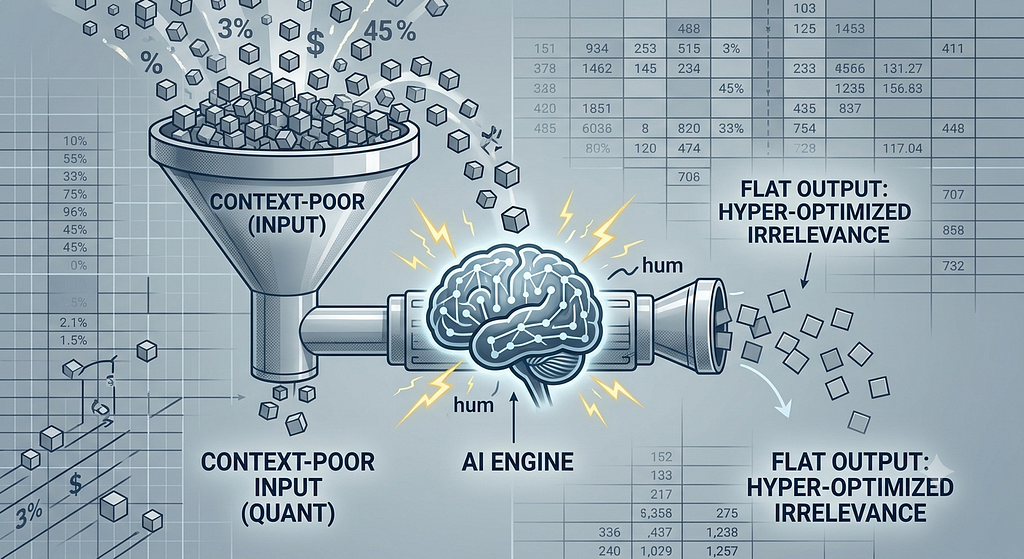
This strategic blind spot turns catastrophic when we introduce Artificial Intelligence into the product development lifecycle. Every tech leader is looking to AI to unlock breakthrough strategies, surface non-obvious patterns, and automate decision-making.
But they forget the foundational law of computing: Garbage In, Garbage Out (GIGO).
In the age of LLMs and predictive AI, we need to redefine what “garbage” means. Garbage doesn’t just mean a corrupted database or poorly formatted CSV files. Garbage means context-poor, flattened data.
[ Narrow Telemetry Data ] ──> [ AI Engine ] ──> [ Hyper-Optimized Irrelevance ]
  (Clicks, Drop-offs)                               (Fast answers to wrong problems)
If you feed an AI model nothing but rows of abstract numbers — clicks, timestamps, and pageviews — you are giving it a map of a desert and asking it to find water. The AI can only process, synthesize, and hallucinate within the narrow walls of the sandbox you handed it.
What Happens When AI Lacks Human Context
Imagine you task an AI product agent with increasing engagement for a banking app. If the input data is purely quantitative (transaction frequencies, login intervals, click rates), the AI might suggest aggressive push notifications, gamified reward pop-ups, or micro-targeted credit offers. It creates a hyper-optimized, hyper-annoying engine that drives short-term clicks while destroying long-term brand equity.
Why? Because the AI didn’t know that the underlying human emotion associated with opening a banking app is often financial anxiety.
Now, change the raw material. What happens when you feed an AI an empirical, qualitative dataset? You feed it transcribed user interviews where people confess they avoid checking their balance because it makes them feel guilty. You feed it observations of the chaotic “workarounds” users create — like keeping a messy handwritten notebook of their monthly subscriptions because the app’s categorization layout is too confusing.
Suddenly, the AI has the rich, unstructured human context it needs to be genuinely intelligent. It can find the latent semantic connections between user anxiety and app abandonment, suggesting structural features — like an “anxiety-free” blind balance mode or a proactive subscription-killer tool — that no spreadsheet could have ever implied.
4. The Right Architecture: Human Context to Machine Scale
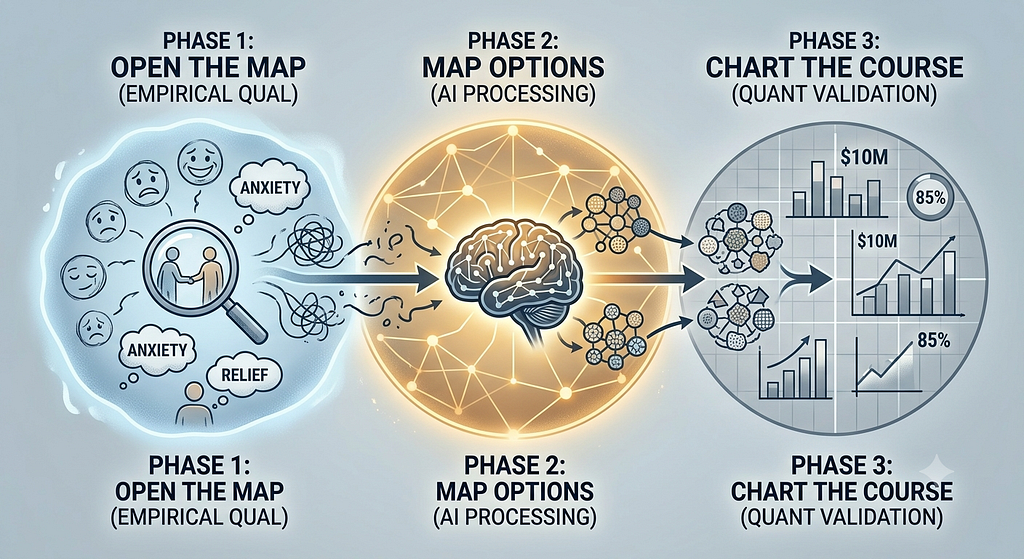
To break out of this trap, we must implement a deliberate, sequential workflow that leverages the divergent power of human empathy and the convergent power of statistics, supercharged by AI.
We must move away from the traditional, narrow pipeline and adopt a three-phase architecture where the sequence dictates the success.
1.Phase 1: Open the Map via Empirical Exploration :Human Discovery.
Do not look at your metrics yet. Go out and observe human behavior in its natural habitat. Document the unarticulated needs, the emotional triggers, the exhausting workarounds, and the systemic frustrations. This phase intentionally blows open the aperture of your lens, creating a massive, high-context, unstructured dataset of alternative realities and untapped opportunities.
2.Phase 2: Synthesize and Map Options via AI Processing :Machine Intelligence.
Take that rich, unstructured qualitative data — the text, the behavioral transcripts, the field notes — and feed it into your AI models. Let the AI do what it does best: parse massive amounts of complex, non-linear human context to find hidden thematic clusters, identify systemic blind spots, and propose a broad spectrum of divergent strategic solutions.
3.Phase 3: Validate and Scale via Quantitative Analysis :Statistical Prioritization.
Now that the empirical phase has opened the doors and the AI has mapped out the unexpected opportunities, bring in your statistics to close the loop. Use your quantitative tools, dashboards, and A/B testing frameworks to stress-test the hypotheses. How many people face this specific emotional roadblock? What is the statistical lift if we build this new door? Use the data as a validator, not an architect.
Conclusion: Stop Measuring the Wrong Room
Starting with quantitative data is like taking a tape measure into a dark, locked room and trying to guess the color of the walls by measuring the height of the ceiling. You will get incredibly precise measurements, but you will remain entirely in the dark.
Better workflows and better input data are the only path to better outputs — whether you are a service designer mapping a customer journey or an engineer tuning a cutting-edge AI agent.
Let qualitative empirical insights open the map of human reality. Let AI help you read the terrain. And let your quantitative metrics tell you how fast you are moving in the right direction. Stop optimizing the status quo, and start building new doors.
Fredy Pascal — Principal UX Strategist & Designer
Ciao ciao
How this piece came to life (my HIAH Process):
✍️ Human First: Pouring raw ideas and unique perspectives into the initial draft.
🤖 AI Enhanced: Cleaning up grammar and sharpening the overall flow.
🎨 AI Image Generation: Crafting custom visuals to bring the concepts to life.
👀 Human Last: The final human touch — rigorous review and verification before hitting “publish.”
Why Quant-First Strategies Blind Your AI and Your Business was originally published in Bootcamp on Medium, where people are continuing the conversation by highlighting and responding to this story.