The Solo Agent Is a Trap. Why Workflows Are the Real AI Superpower
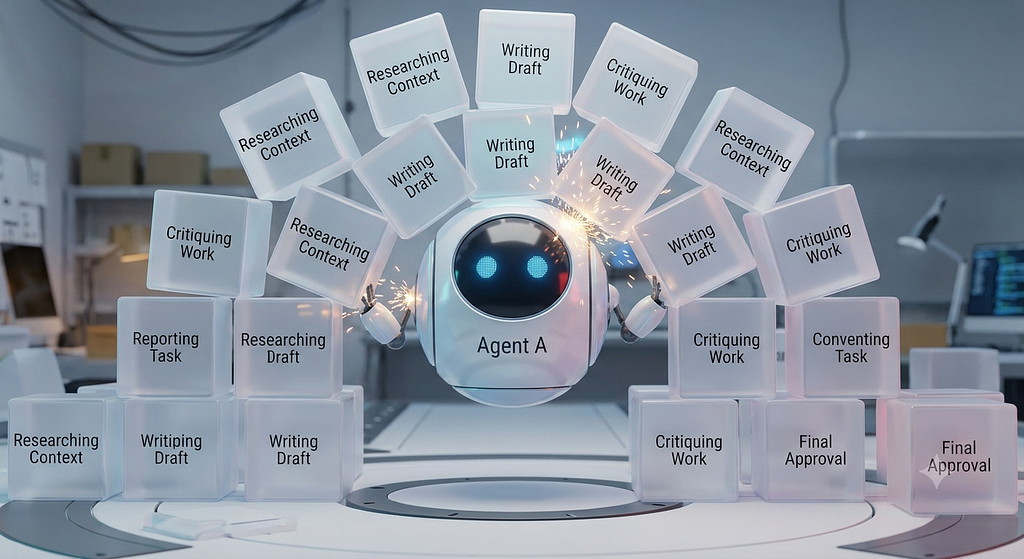
Time to save your AI strategy from the “One Bot to Rule Them All” delusion.
Over the last year, the tech world has fallen victim to a brilliant piece of marketing: the myth of the all-knowing, autonomous AI Agent. We’ve been told that if we just prompt a single agent hard enough, or give it a shiny corporate title like “AI Marketer” or “AI Data Analyst,” it will magically handle a complex, end-to-end business lifecycle.
Somewhere between the hype cycles, we fell into a massive engineering trap. We expected a single AI instance to act like a human employee, juggling a dozen shifting contexts simultaneously.
But here is the cold, empirical truth: Single agents don’t scale. Agentic workflows do. If you want your AI strategy to deliver predictable, production-grade value instead of erratic, unpredictable demos, it’s time to stop building solo bots and start building automated assembly lines.
From Omnipotent Bots to Fragmented Realities
Remember when the promise of agents was simple? “Just give it a goal, let it browse the web, and it will execute.” In reality, asking a single agent to handle a complex task — like writing an industry report, auditing code, or managing customer onboarding — is a recipe for a spectacular, hallucination-filled meltdown.
When a single agent is forced to plan, retrieve data, analyze, critique, and format an output all in one go, its context window turns into a chaotic soup. It tries to do everything at once and ends up doing nothing reliably.
Technically, putting all your faith in a single, massive prompt is lazy architecture. Experientially, it leads to flaky outputs that non-experts can’t trust.
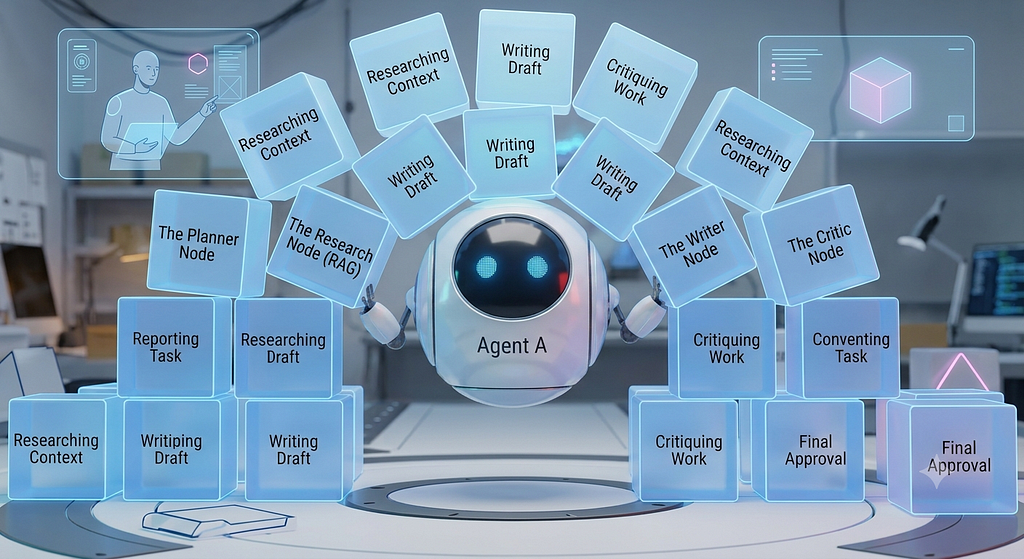
Jargon Over Journeys: The Agent vs. The Assembly Line
Product teams frequently waste months trying to build the “perfect” agent by packing instructions into a single system prompt. They treat AI like a magical black box rather than a modular design material.
The real breakthrough happens when you realize that AI models perform exponentially better when they are restricted to small, hyper-specific micro-tasks, connected by a rigid programmatic pipeline.
The Solo Agent IllusionThe Agentic Workflow RealityThe Setup: One massive prompt trying to execute a multi-step project.The Setup: A sequence of distinct AI nodes, each optimized for exactly one micro-task.The Output: Highly unpredictable, prone to wandering off-script or hallucinating.The Output: Predictable, structured, and easily auditable at every single step.The Debugging: Changing one sentence in the prompt breaks three other behaviors.The Debugging: If step 3 fails, you simply swap out or tweak the prompt for node 3.The Focus: Optimizing for model “smartness.”The Focus: Optimizing for predictable business outcomes.
The Workflow Blueprint: Give AI a Chaperone
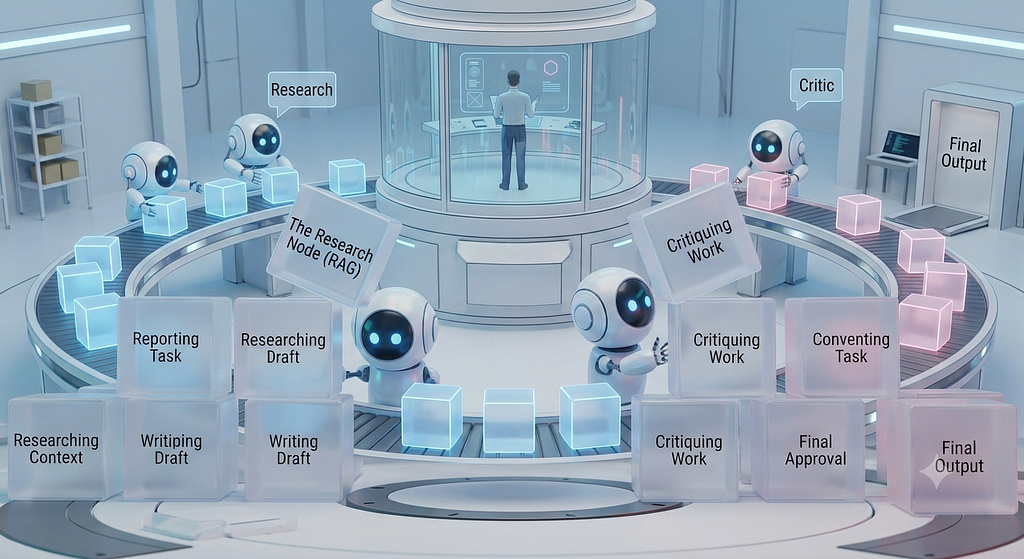
To unlock meaningful ROI, we need to transition from an open-ended “chat box” mindset to a structured, iterative workflow. An agentic workflow treats the LLM as a processing engine within a larger, code-governed assembly line.
Consider how a high-performing content generation or research pipeline actually works when broken down into an intentional workflow:
- The Planner Node: Takes the user’s brief and breaks it down into an explicit, structured outline.
- The Research Node (RAG): Takes the outline, fetches specific articles, and extracts raw data.
- The Writer Node: Takes the extracted facts and writes a rough first draft.
- The Critic Node: Reviews the draft against a strict quality checklist, flagging inaccuracies or bad formatting.
- The Refiner Node: Rewrites the draft based only on the Critic’s explicit feedback.
By breaking the journey into distinct phases, you drastically lower the cognitive load on the underlying model. The AI is no longer guessing what to do next; it is executing a highly orchestrated choreography where the output of one step is the structured input for the next.
Practical Moves for yourteams
Ready to shift your strategy from fragile AI bots to resilient machine workflows? Put these steps on your immediate roadmap:
- Deconstruct Your “Super Bots” into Micro-Steps: Look at your backlog. If you have an item named “Build an AI Assistant to write legal briefs,” delete it. Instead, write: “Build an AI pipeline that extracts clauses, checks compliance, and generates a draft.”
- Implement the “Critic” Pattern: Never let the agent that generates the content be the one that approves it. Always introduce a dedicated “Reviewer” or “Critic” agent node whose sole job is to find flaws and demand a rewrite.
- Keep Humans in the Loop at Critical Gates: Workflows make it incredibly easy to pause the system. Don’t let an AI chain run entirely autonomous from end to end. Build a visual interface that pauses the workflow after the “Planning” phase, allowing a human to click “Approve” before the machine spends API tokens on execution.
- Measure Node-Level Friction: Stop measuring the overall success of a prompt based on a vibe check. Track exactly which node in your workflow triggers the most errors, hallucinations, or latency, and optimize that specific point.
The Invitation: Reclaim Workflow Mastery
AI models will continue to grow faster and cheaper. But a faster engine doesn’t matter if the assembly line is fundamentally broken.
Never forget: An agent is just an architectural component. The workflow is the actual product.
True simplicity, predictability, and business value won’t emerge from the sophistication of a single model. It will come from product teams, engineers, and strategists explicitly choosing to build resilient, human-designed workflows that guide AI step-by-step toward meaningful outcomes.
Fredy Pascal — https://fredypascal.com/
Principal Designer & Strategist
Ciao ciao
The Solo Agent Is a Trap. Why Workflows Are the Real AI Superpower was originally published in Bootcamp on Medium, where people are continuing the conversation by highlighting and responding to this story.