The Power of Comedy Techniques in Design and Research Workshops
When you think about presenting research findings or explaining complex design concepts, comedy might not be the first tool that comes to mind.
Yet, stand-up comedians are masterful communicators who have perfected the art of engaging audiences, holding attention, and making information stick. By borrowing stand-up techniques and infusing humor into design and research presentations, you can transform dry technical explanations into compelling narratives that resonate with audiences and drive meaningful engagement.
Why Comedy Works in Professional Settings
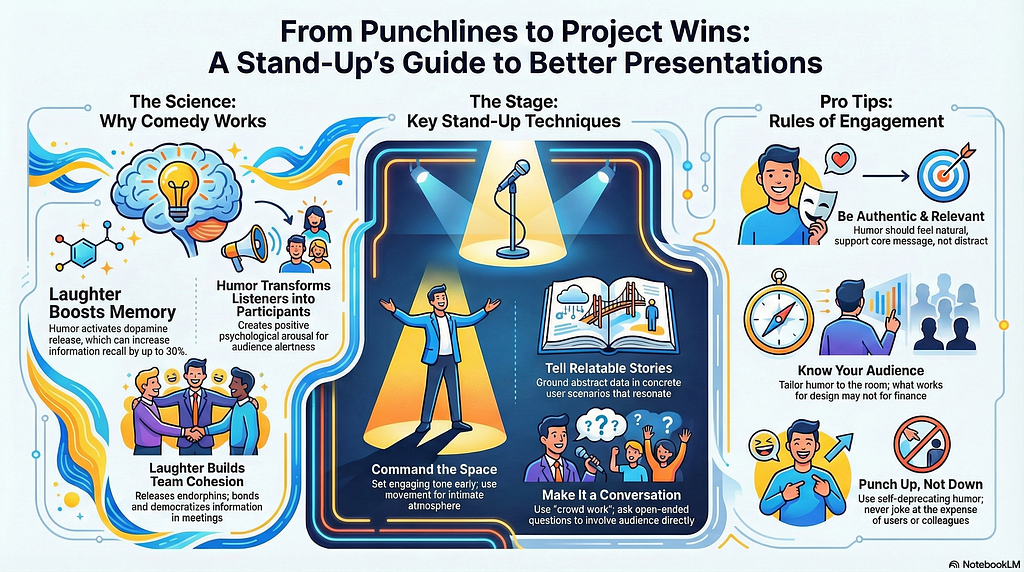
The intersection of comedy and professional communication is grounded in psychology and cognitive science. When audiences laugh, their brains release dopamine, a neurotransmitter essential for memory formation and learning. This biochemical response fundamentally changes how people process and retain information.
Research consistently demonstrates that humor increases information recall by up to 30% in educational settings. When humor is presented, it creates positive psychological arousal that transforms passive listeners into active participants who are more alert and engaged. The positive emotions triggered by laughter reduce tension and anxiety, which promotes thinking and enhances the ability to integrate diverse materials — exactly what’s needed when explaining complex design or research concepts.
Beyond individual cognition, humor creates group cohesion. Laughter releases endorphins that promote bonding and strengthen relationships within teams. In cross-functional presentations, humor also democratizes information by eliminating hierarchical distance — everyone is equal in a moment of genuine laughter.
Stand-Up Comedy Techniques for Design and Research Communication
1. Control the Room by Setting Tone Early
Stand-up comedians understand that their opening sets the entire trajectory for audience engagement. They signal early when it’s time to laugh and participate, transforming passive listeners into active participants.
In design or research presentations, start with something surprising or genuinely funny that signals engagement. This could be a humorous opening statistic, a relatable problem scenario, or a funny observation about your research process. By establishing this tone early, you create an implicit contract that your presentation will be engaging, not tedious.
2. Use Physical Presence and Movement
Comedians never hide behind podiums. They move through space, use gestures, make facial expressions, and maintain eye contact. This physical engagement creates intimacy and eliminates the invisible barrier where jokes — and important information — fall flat.
When presenting, embrace movement. Move around your presentation space, use hand gestures to emphasize key points, and vary your facial expressions. This physical energy communicates confidence and passion about your work while humanizing you. Your audience feels connected to you as a person, not just receiving information from an authority figure.
3. Master Timing and Silence
Comedians know that the pause is as important as the punchline. After delivering a joke, they wait, letting the audience process the humor. This silence strengthens timing and gives laughter room to develop.
Apply this to presentations. After making a key point or sharing a funny insight, pause. Let it land. This breathing room gives audiences time to process information and demonstrates confidence in what you’re saying. Silence becomes an ally rather than an enemy.
4. Practice Crowd Work and Audience Engagement
Stand-up comedians use “crowd work” — calling out specific people, asking questions, and making jokes based on responses. This keeps people alert, involved, and personally acknowledged. When audience members become participants rather than passive observers, they’re fully engaged.
In research and design presentations, incorporate interactive elements. Ask open-ended questions: “Why do you think users struggled with this?” rather than “Do you understand this?” Invite stakeholders to share experiences. When someone raises a point, acknowledge it with insight or gentle humor. This transforms your presentation from a monologue into a conversation, significantly increasing engagement and buy-in for recommendations.
5. Tell Stories with Relatable Details
Comedians tell specific stories grounded in recognizable situations. People laugh at the truth in detailed descriptions that resonate with their experiences. A comedian discussing an awkward dinner party gets laughs because everyone relates to that scenario.
When presenting research or design, use this approach. Instead of “statistically significant improvement in cognitive function,” try “participants could finally remember their passwords without writing them down.” Ground findings in concrete, relatable scenarios. Share specific user stories and participant quotes that bring research to life. When people see themselves in your examples, findings become memorable and actionable.
6. Use Visual Storytelling and Props
Stand-up comedians incorporate props — objects, videos, or visual gags — to enhance their comedy. These tangible elements break monotony and add layers of engagement.
For design and research presentations, visual storytelling becomes your “prop.” Use videos of actual users interacting with designs. Include screenshots or photos that illustrate points. String together impactful participant videos that tell stories. Visual elements not only break up text-heavy slides but also provide concrete evidence that’s harder to dismiss.
7. Handle Disruptions with Humor
When something goes wrong — a technical glitch or unexpected comment — comedians acknowledge it with humor and redirect smoothly. This ability to handle unexpected moments keeps engagement running and often generates genuine connection.
In professional presentations, disruptions are inevitable. A stakeholder might challenge findings, technology might fail, or someone might ask a tough question. Rather than getting defensive, acknowledge it with humor: “Well, that’s exactly the feedback we got in user testing — nobody expected that either!” This humanizes you, defuses tension, and often turns potentially negative moments into connection points.
Practical Applications
UX Research Presentations
When presenting user research, incorporate comedy through relatable user scenarios and humorous personas. Instead of generic personas like “Tech-Savvy Millennial,” create exaggerated, memorable versions like “Coffee-Addicted Superhero Mom Who’s Always Running Late But Still Saves the Day”. These personas make research insights stick with stakeholders.
Use comedic storytelling: “Here’s what happened when we asked users to find the checkout button: silence, awkward scrolling, and then one participant asked, ‘Is there another website?’” This approach makes research feel alive rather than abstract.
Design Thinking Workshops
During design sessions, use humor to create psychological safety and encourage creativity. Start with funny brainstorming activities that help participants bypass their inner critic. Make self-deprecating comments about design failures or observations about your creative process. When teams laugh together, they build trust and become more willing to take creative risks — essential for innovation.
Stakeholder Communication
When communicating research or design recommendations, humor makes complex information accessible and memorable. Frame findings through relatable problems: “Currently, users spend an average of 4 minutes looking for a button that should take 4 seconds to find. That’s like searching for your keys every morning.”
Use humor to make recommendations feel less threatening. Instead of “Your current design is causing user frustration,” try “Our research uncovered a 4-minute treasure hunt that’s probably not the experience you intended.” This approach makes stakeholders more receptive to feedback.
The Science Behind Memory and Creative Thinking
Humor activates the reward center in the brain, creating a relaxed mental state that enhances creative thinking and problem-solving. When people are in a positive mood induced by humor, they become more receptive to new ideas and more willing to think outside the box.
The enhanced recall from humorous content happens because humor creates positive associations. When people laugh at an example related to your research, they’re more likely to retrieve that information later because it’s tied to a pleasant emotional memory. For designers and researchers trying to influence stakeholder decisions, this is invaluable.
Key Guidelines for Using Comedy
Authenticity Over Punchlines: The most effective humor in professional presentations isn’t joke-heavy — it’s authentic and grounded in truth. Self-deprecating humor often lands better than perfectly crafted jokes.
Relevance Is Essential: Every humorous element should serve your core message. If a joke doesn’t directly relate to your research or design, it’s distraction rather than enhancement.
Know Your Audience: Understanding your audience’s humor preferences is crucial. What works for a creative design team might not work in a corporate finance meeting. Tailor your approach accordingly.
Avoid Punching Down: Effective comedy punches up or sideways, never down. Don’t use humor at the expense of users or participants. Self-deprecating humor about your own mistakes lands well; humor mocking others creates distance and damages credibility.
Time Management: Humor takes time. Pauses, crowd work, and storytelling can’t be rushed. Build extra time into your schedule. It’s better to deliver 80% of content with engagement than to rush through 100% and bore everyone.
So what…
Stand-up comedy techniques aren’t about turning research presentations into comedy shows — they’re about applying time-tested methods for capturing attention, building connection, and making information memorable. Comedians have spent decades perfecting communication methods that align with how human brains process information and form memories.
By adopting stand-up techniques — controlling room tone, using physical presence, mastering timing, engaging audiences as participants, telling relatable stories, and handling disruptions gracefully — you fundamentally transform how people receive and remember your design insights and research findings. Your audience doesn’t just hear your message; they feel connected to you, laugh with you, and walk away with information they’ll actually remember and act upon.
In a world of endless presentations and information overload, the ability to make people laugh while delivering meaningful insights is a competitive advantage. Your research deserves to be heard. Your design deserves to be understood. Comedy is the vehicle that gets both there.
Fredy Pascal (Linkedin)
Principal Service Designer
Ciao ciao
The Power of Comedy Techniques in Design and Research Workshops was originally published in Bootcamp on Medium, where people are continuing the conversation by highlighting and responding to this story.